
Blood transfusion is one of the most
remarkable advancements in modern healthcare — a procedure that can turn a
critical situation into a hopeful one within minutes. By delivering blood or blood
components directly into the bloodstream through an IV line, it restores
essential functions in the body and supports survival during severe illness or
injury.
Understanding the Basics
Our blood is a complex, living tissue
made up of different components:
●
Red Blood Cells (RBCs): Carry oxygen to
every part of the body.
●
White Blood Cells (WBCs): Defend against
infection.
●
Platelets: Help in clotting to prevent
excessive bleeding.
●
Plasma: The liquid component that
transports nutrients, hormones, and proteins.
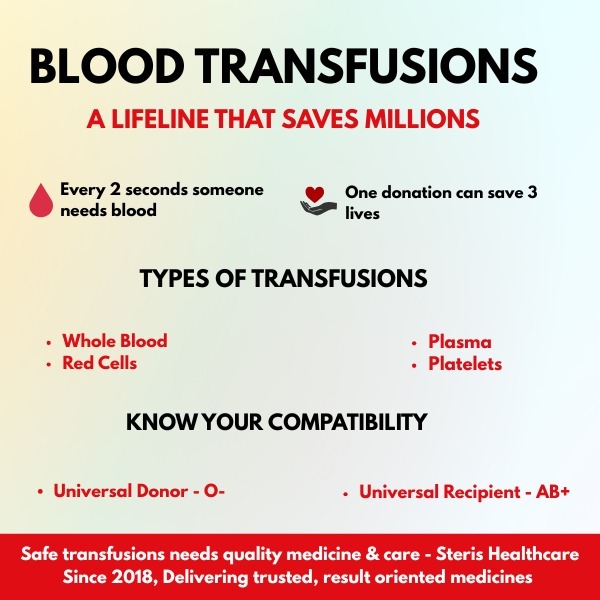
A transfusion might use whole blood or
specific components, depending on the patient’s needs.
Antigens and Antibodies –
The Blood’s Security System
Blood safety depends on the
compatibility between donor and recipient. This compatibility revolves around
two important terms:
●
Antigens: Proteins or markers on the
surface of red blood cells that determine blood type.
●
Antibodies: Protective proteins in the
plasma that identify and neutralize foreign antigens.
If incompatible blood is transfused,
the immune system sees it as a threat, leading to dangerous reactions.
Types of Blood
Transfusions
Whole Blood Transfusion
●
Content: RBCs, WBCs, platelets, plasma.
●
Use: Severe blood loss due to trauma or
surgery.
Red Blood Cell Transfusion
●
Content: Concentrated RBCs rich in
hemoglobin.
●
Use: Anemia, sickle cell anemia,
surgical blood loss.
Plasma Transfusion
●
Content: Fluid portion of blood
containing clotting factors.
●
Use: Coagulation disorders, severe
burns, liver disease.
Platelet Transfusion
●
Content: Small cell fragments aiding in
blood clotting.
●
Use: Cancer treatment side effects,
platelet disorders.
Blood Type Compatibility
Blood type is determined by the
presence or absence of certain antigens (A, B, Rh factor).
●
Universal Donor:
O negative (O−) — can donate to anyone.
●
Universal Recipient: AB positive (AB+) —
can receive from anyone.
Simple Analogy:
Negative (−) people can only receive help from others like them but can give
help to everyone. Positive (+) people can give love freely but also receive it
from anyone.
Possible Adverse
Reactions
Although transfusions are generally
safe, risks exist:
- Hemolytic Reaction:
○
Cause: Incompatible blood.
○
Symptoms: Back pain, rapid
heart rate, chills, dark urine, low BP.
- Allergic Reaction:
○
Cause: Immune response to donor
proteins.
○
Symptoms: Hives, itching,
swelling, nausea, breathing difficulty.
- Febrile Reaction:
○
Cause: Reaction to donor white
cells.
○
Symptoms: Fever, chills,
headache, flushing.
Why Blood Donation
Matters
Every two seconds, someone somewhere
needs blood. One donation can save up to three lives — trauma patients,
newborns with severe anemia, cancer patients undergoing chemotherapy, or
surgery patients. Regular donation not only supports others but can also
benefit the donor’s health by maintaining balanced iron levels.
Final Word
Blood transfusions are a testament to
how human generosity, scientific advancement, and healthcare infrastructure
come together to save lives. But behind every safe and effective transfusion is
the quality of medical products, storage, and handling.
Steris Healthcare Pvt. Ltd., active in
the market since 2018, plays a crucial role in providing a wide range of
result-oriented medicines that doctors trust. From life-saving drugs to
supportive treatments post-transfusion, Steris Healthcare ensures that patients
get quality, efficacy, and safety in every dose — because in healthcare, every
detail matters.